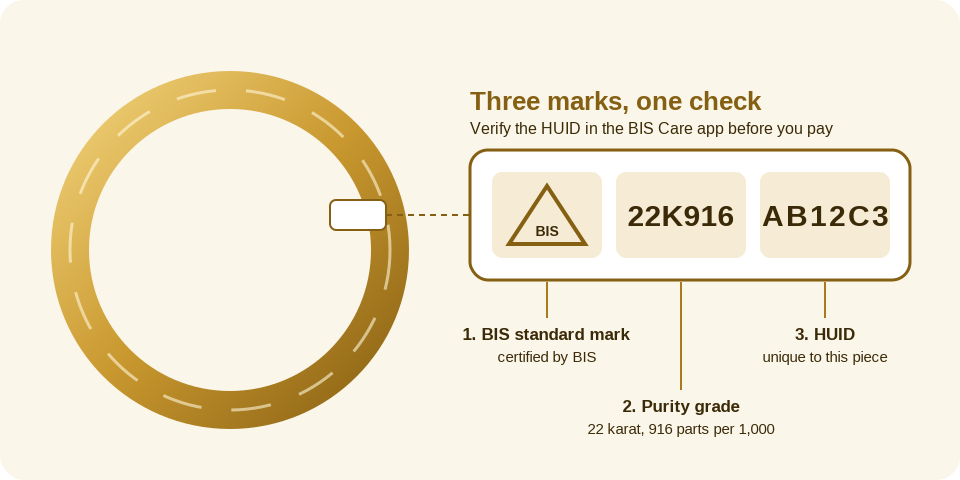
A hallmark is the Bureau of Indian Standards' guarantee that a piece of gold jewellery is as pure as the seller says. Every piece is tested at a BIS-recognised assaying and hallmarking centre against the Indian Standard IS 1417:2016, and only pieces that pass are marked. Since 2021 each hallmark has also carried a code that is unique to that one piece, so you can look it up yourself in a few seconds.
Where hallmarking is compulsory
Mandatory hallmarking began on 23 June 2021 in 256 districts. It has been extended in phases since then; the sixth phase, from 2 March 2026, took it to 380 districts. By March 2026 more than 60 crore gold items had been hallmarked with a HUID. In those districts a jeweller may not sell gold jewellery or artefacts without a hallmark.
The three marks on hallmarked gold
- The BIS standard mark. The triangular BIS logo, showing the piece was certified under the BIS scheme.
- The purity grade. The karat and the fineness together, such as 22K916: 22 karat, with 916 parts of gold in every 1,000.
- The HUID. A six-character alphanumeric Hallmark Unique Identification, such as AB12C3, laser-marked on the piece. No two pieces share a HUID.
The marks are tiny. Ask the jeweller for a magnifying loupe; they are usually on the clasp, the hook of an earring or the inside of a bangle or ring.
The purity grades you can see
Hallmarked gold jewellery can carry only these grades:
| Mark | Karat | Gold content |
|---|---|---|
| 24K995 | 24 karat | 99.5% |
| 23K958 | 23 karat | 95.8% |
| 22K916 | 22 karat | 91.6% |
| 20K833 | 20 karat | 83.3% |
| 18K750 | 18 karat | 75.0% |
| 14K585 | 14 karat | 58.5% |
| 9K375 | 9 karat (mandatory since July 2025) | 37.5% |
A different number, or a karat stamp with no fineness and no HUID, is not a BIS hallmark. For how the grades compare on price and wear, see 22K vs 24K gold.
How to verify a HUID before you pay
- Find the six-character HUID on the piece, and check that the same code is printed on your bill.
- Install the official BIS Care app and choose the option to verify a HUID.
- Type in the code. The app shows what was recorded when the piece was hallmarked, including its purity and the type of article, along with the registered jeweller and the hallmarking centre.
- Check that the article type and purity match what you are holding and what the bill says. If they don't, don't pay.
Old jewellery without a HUID
Before July 2021, hallmarks used four marks and no HUID. Jewellers were given until 31 March 2023 to clear that stock; since then they have been allowed to sell only hallmarked jewellery that carries a six-digit HUID. The rule is about what shops sell: jewellery you already own with an old hallmark, or with none, can still be worn, exchanged or sold, and the jeweller will test its purity when you do.
What hallmarking costs
BIS raised the hallmarking charge to ₹75 per gold article in September 2026, from ₹45, with a minimum of ₹200 a consignment. The jeweller pays the hallmarking centre and normally passes the fee on, so expect about ₹75 a piece on your bill. TrueGoldRate's jewellery price calculator leaves it out, so add it when you compare quotes.
If the purity is wrong
You can lodge a complaint with BIS through the same BIS Care app. Keep the bill, which should list the HUID, purity, net weight and the charges separately, because the complaint is made against those details.