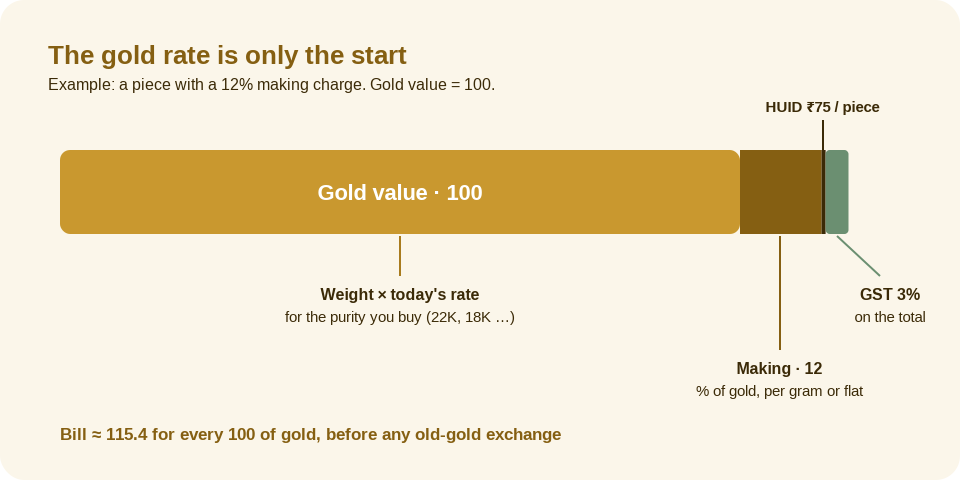
The gold rate you see on a jeweller's board, or on TrueGoldRate, is the price of the metal alone. A piece of jewellery costs more because the bill adds making charges, the hallmarking fee and GST. Two shops can use exactly the same gold rate and still quote very different prices for similar pieces; the difference is almost always the making charge.
What making charges cover
Making charges pay for the labour and design that turn gold into jewellery, and for the metal lost while it is cut, filed and polished. In much of south India that loss is billed separately as "wastage" or "value addition" (VA), usually as a percentage. Either way, it is part of what you pay over and above the gold.
Three ways shops charge
- A percentage of the gold value. The most common method; typical rates run from about 8% to 25%.
- A fixed amount per gram. Common for machine-made chains and plain bangles.
- A flat charge per piece. Used for small items such as rings and earrings.
Machine-made, plain pieces sit at the low end. Handmade, intricate and antique-finish work, such as temple, kundan or filigree jewellery, sits at the high end.
How the bill adds up
GST of 3% applies to the whole amount: gold value, making charges and the hallmarking fee together. The BIS hallmarking charge is ₹75 a piece since September 2026; read how to check the HUID it pays for.
Worked example: 10 grams of 22K with a 12% making charge
| Gold value (10 g × ₹11,850) | ₹1,18,500 |
| Making charges (12%) | ₹14,220 |
| Hallmarking (1 piece) | ₹75 |
| GST (3%) | ₹3,984 |
| Total | ₹1,36,779 |
That works out to ₹13,678 a gram, about 15% above the gold rate. Uses the India 22K rate for 28 November 2026. Try your own numbers in the jewellery price calculator.
How to compare shops
- Ask for the all-in price per gram, after making charges and GST. It is the only number that compares like with like.
- Check that the bill shows the net gold weight. Stones, beads and enamel should be weighed and priced separately, not charged at the gold rate.
- Read "zero making charge" offers carefully: check the gold rate used and whether wastage is billed instead.
- If you are exchanging old gold, ask how its purity will be tested and what deduction applies, and get the exchange value in writing before choosing the new piece.
- Keep the bill. It should list the HUID, purity, net weight, gold rate, making charges and GST separately.
Making charges vary far more between shops than the gold rate does between cities; see why rates differ by city.