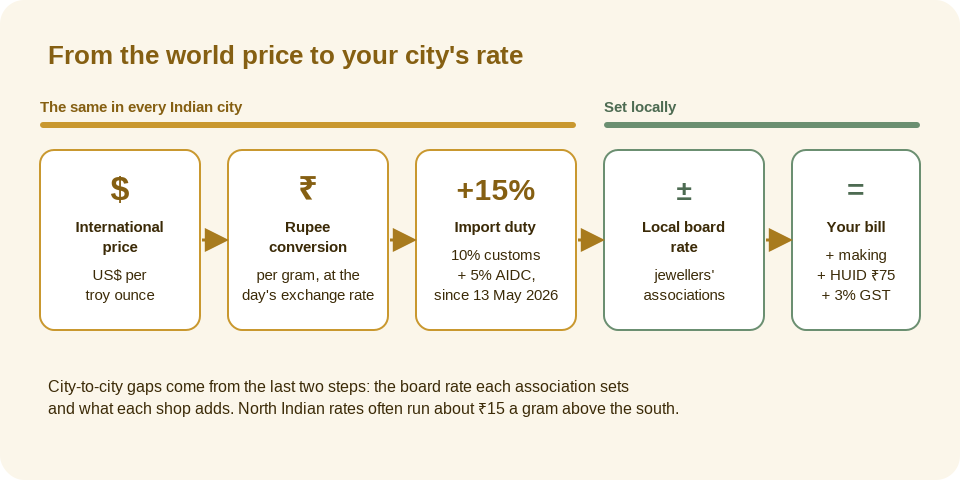
Gold is traded worldwide at one price, yet the 22K rate in Delhi is not always the rate in Chennai. Most of the price is set nationally; the gaps between cities come from a few rupees added or taken away at the local end, and from what each shop charges on top.
1. The international price
Everything starts from the international spot price, quoted in US dollars per troy ounce (31.1 grams). It moves around the clock with trading in London, New York and Asia, and it is the same for every Indian city.
2. The rupee
The dollar price is converted to rupees per gram at the day's exchange rate. A weaker rupee makes gold dearer in India even when the world price has not moved.
3. Import duty
India imports almost all its gold, and customs duty is added to every gram. Since 13 May 2026 the duty is 15%: a 10% basic customs duty plus a 5% Agriculture Infrastructure and Development Cess, up from 6% before. Duty is the same at every port, so it raises prices everywhere equally. TrueGoldRate's methodology page lists every change since 2015.
4. The local board rate
This is where cities part ways. Jewellers' and bullion associations publish a daily rate that local shops follow, and each one prices in its own costs and competition:
- The India Bullion and Jewellers Association in Mumbai publishes the benchmark wholesale rates much of the country quotes.
- In Chennai, shops follow a common board rate agreed through the Jewellers and Diamond Traders Association of Madras.
- In Kerala, the All Kerala Gold and Silver Merchants Association sets one rate for the whole state each morning.
- In Lucknow, the sarafa association publishes the city's 24K, 22K and 18K rates.
Transport, insurance and security costs, local demand and how keenly shops compete all feed into these numbers. In practice the gaps are small: when TrueGoldRate last compared the market, 22K rates in Delhi, Uttar Pradesh, Rajasthan, Punjab, Haryana and Chandigarh ran about ₹15 a gram above the national figure, and Gujarat and Bihar about ₹5 above.
22K rates in major cities today
| City | 22K per gram | vs India |
|---|---|---|
| Chennai | ₹11,850 | same |
| Mumbai | ₹11,850 | same |
| Delhi | ₹11,865 | +₹15 |
| Kolkata | ₹11,850 | same |
| Bangalore | ₹11,850 | same |
| Kerala | ₹11,850 | same |
| Ahmedabad | ₹11,855 | +₹5 |
| Lucknow | ₹11,865 | +₹15 |
| Jaipur | ₹11,865 | +₹15 |
| Patna | ₹11,855 | +₹5 |
28 November 2026. India 22K: ₹11,850 a gram. Every city's rate is on the gold rates page.
5. The shop's own charges
Finally, each shop adds its making charges, the ₹75 hallmarking fee and 3% GST. These vary far more than the board rate: a few percentage points of making charge outweigh any difference between cities. See how making charges work.
What this means when you buy
- Check your own city's rate on the day, but don't travel to another city to save a few rupees a gram.
- Compare shops on the all-in price per gram, not the board rate.
- Buy only hallmarked jewellery and verify the HUID: see how to read a HUID hallmark.